Vintage radiograms: what they are and how to spot a good one
Radio and record player in one timber cabinet, and the centre of the post-war Aussie lounge. What it is, how to spot a good one, and the one thing not to do to it.
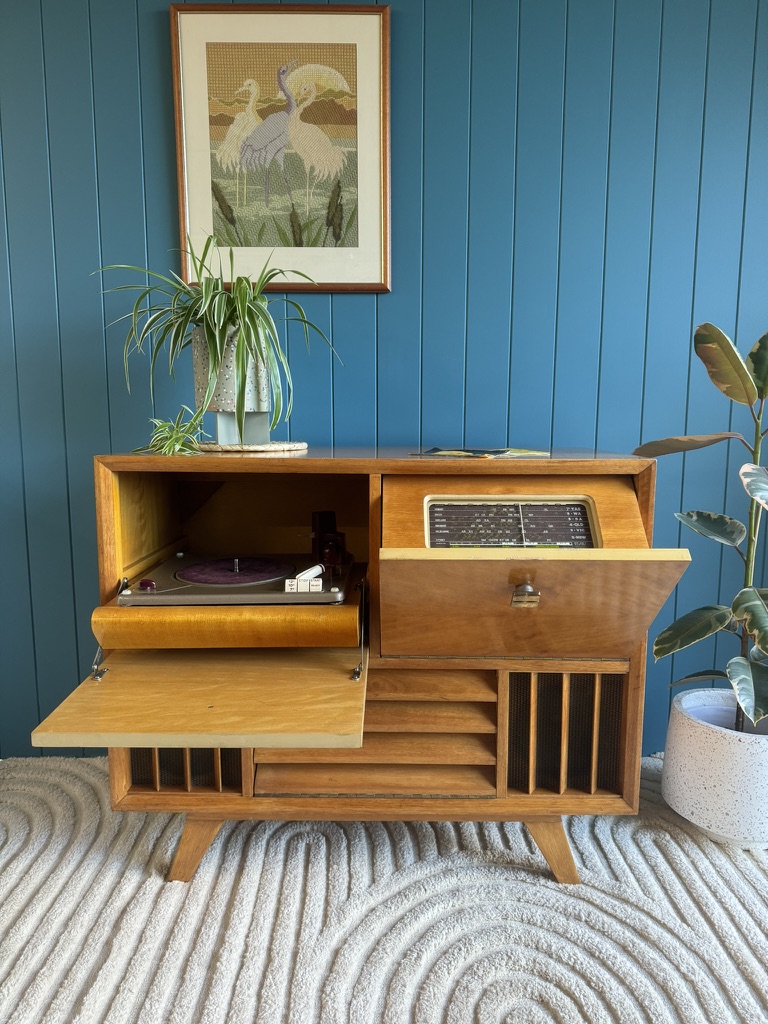
In a 1955 Queenslander lounge room, the most expensive thing usually wasn't the telly. Barely anyone had one yet (Australian television didn't switch on until 1956). It was a long timber cabinet with a lift-up lid, sitting where everyone could gather round it: the radiogram.
Radiogram, or stereogram?
The name is a portmanteau (an excellent word btw) of radio and gramophone, and that was the whole idea: one cabinet, a radio down one end, a record player under the lid and speakers built into the sides. After the war was over, it was the centrepiece of the room, the thing the family sat around in the evening before television pinched that job.
Here's the bit people mix up. A radiogram is mono, short for monophonic: one channel of sound, coming at you from the one spot. Stereo, short for stereophonic, splits it into two, a left and a right, so the sound spreads out across the room. When stereo records arrived at the end of the 1950s, the makers pushed two sets of speakers out to the far corners of the cabinet and gave it a new name: the stereogram. So a "radiogram" with proper left-and-right sound is really a stereogram. Same furniture, one more channel.
We made our own, too. Kriesler built them in Sydney, AWA had the Radiola, and Stromberg-Carlson put sets together here under licence, along with dozens of house brands.
Reading the dial
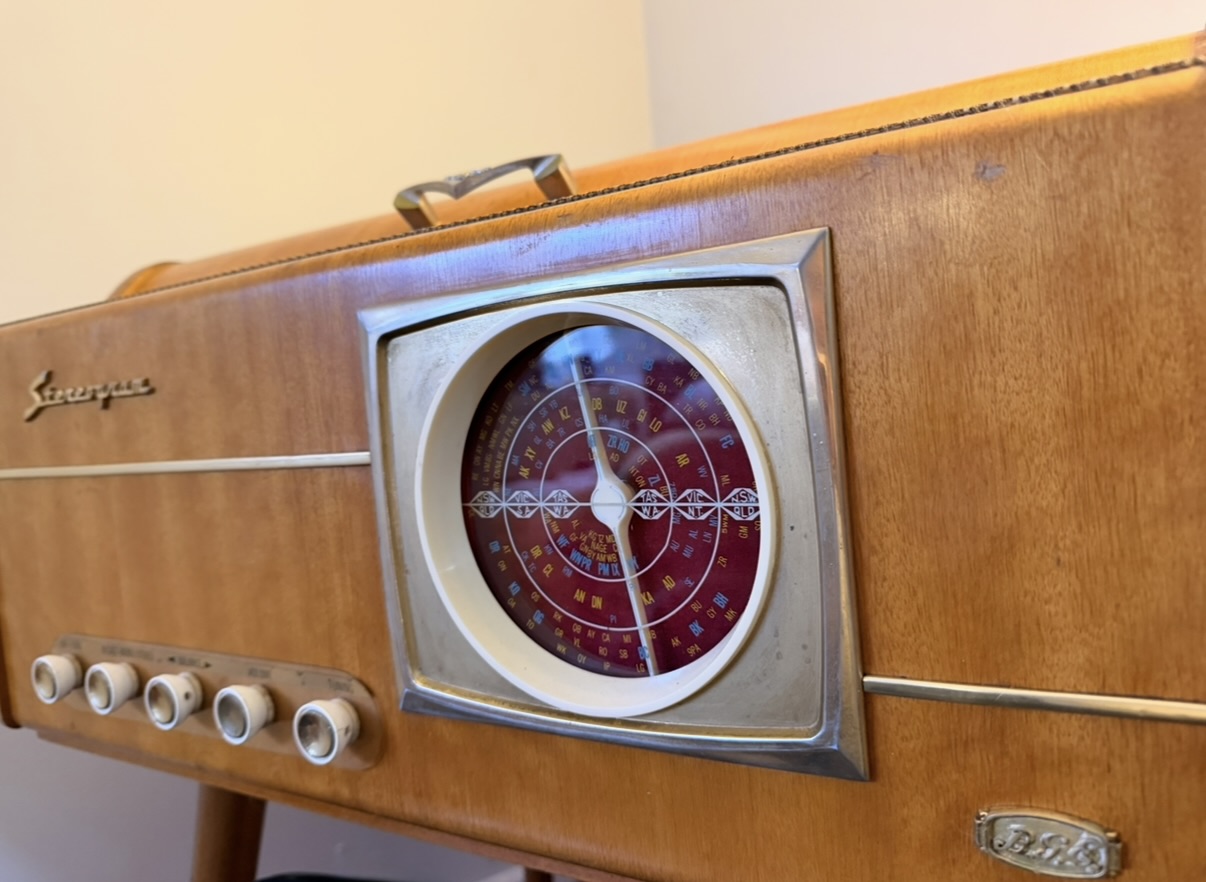
Let's get a bit techy for a sec so you can sound smart at your next barbecue. Run your eye along an old Aussie radiogram dial and there's more on there than you'd expect. The normal AM stations live on the mediumwave band. Shortwave, marked further along, sits higher up the spectrum and does something clever: the signal bounces off the upper atmosphere and can travel right across an ocean, which is how a family in Brisbane once caught Radio Australia or the BBC after dark. Longwave sits below the lot and was mostly a European habit, so plenty of Australian dials skip it.
Now the fun one: you'll often find no FM at all. That's not a fault. Australia ran experimental FM from 1947, then switched it off in 1961 to hand the airwaves to television, and didn't bring FM radio back until 1974. For thirteen years we simply didn't have it, so a lot of these cabinets were built for a dial that never included the stations you'd reach for today.
(And if you're extra curious: AM is amplitude modulation, the older, slightly hissy one; FM is frequency modulation, which came later, sounds clearer, and could carry stereo. Which is the other reason FM and the stereogram turned up around the same time.)
Why they're back
Vinyl is selling again (did it ever stop!?), warm brown timber is having a proper moment, and a radiogram does one thing a shelf of little black boxes can't: it hides all your gear in a single good-looking piece and reads as furniture, not a setup.
How to spot a good one
Lift the lid. You want the original turntable and the valves still in place, not a hollowed-out box with a cheap speaker rattling inside. Feel along the top for veneer that's bubbling or lifting, a sign it's lived somewhere damp (Brisbane, take a bow). Plug it in if you can: valves need a minute to warm up, so you're after a soft hum then sound, with the turntable spinning at a steady pace. A perished rubber idler wheel is common and fixable, but price it in.
And keep an eye out for the deluxe ones. My dad just brought home a console with a reel-to-reel tape deck built into it (open-reel tape being how you recorded at home long before cassettes). A radiogram with a tape deck was the top of the range in its day, and a lovely thing to stumble on now.
The one thing people get wrong
Gutting it. It's tempting to rip out the "old" insides and drop in a fancy speaker, but do that and you've thrown away the warm valve sound and most of the value in one go. The better move: restore the original, then add Bluetooth alongside, so you can stream as well as spin records. Best of both, nothing lost.
Buy on Stuff Exchange right now
A radiogram isn't old technology. It's a speaker that happens to be lovely furniture. Keep the guts, add the Bluetooth, and you get both.
PS: if the one you find needs a bit of love, my dad's your man. He restores these (reel-to-reels and all), and you can find him in Stuff Exchange's Little Black Book of people that fix things (Stereo Fixations), so you'll be able to track him down right here.