How does a vintage dealer price furniture? We asked one
How do you price a piece of vintage furniture? Am I too high? Too low? So I asked someone who's been doing it for 12 years!

How do you price a piece of vintage furniture? ...If you sell, you've asked yourself that more times than you'd admit. Am I too high? Too low? How does everyone else do it? So I asked someone who's been doing it for 12 years!
James Gorry was one of the very first sellers on Stuff Exchange, so I popped over to his inner-city townhouse to find out.
He made me a proper cup of Irish tea, and I took it all in.
Tiffany lamps throwing coloured light around the room. Art on every wall (some of it a little cheeky...). Plants inside and out on the porch, family photos everywhere, and a pile of catalogues from his father's gallery in Dublin stacked high. There's a bar cabinet stamped Germany 1942.
The coffee table is an original TH Brown Rondo Pouffé Table in round smoky glass, stamps and all, with little seats made to tuck perfectly underneath and a chess board sitting on top.
And the workshop? That's in the double garage... a real luxury for an inner-city townhouse!
A bet on mid-century
James came to Australia from Ireland 35 years ago. Art runs in the family: he worked alongside his father at the Gorry Gallery in Dublin, which still deals in Irish paintings and sculpture today.
What struck him here was that Australia didn't really have an antiques trade the way Ireland and Europe did. Too young for the 100-year-old definition. So he made a bet that mid-century furniture would become Australia's antiques.
"There's quite a lot of history behind Australian furniture, as it was derived from some of the designs from Danish furniture."
He started on eBay, got tired of the fees, and has been buying and selling ever since. These days, as he puts it, "you have every antique shop in your pocket." He also admits he's ended up keeping a lot of the good stuff for himself. "It's like good wine. You regret opening it."
So... how does he price?
Plot twist... he starts at the end!
"I work to what it's worth from a retail perspective and work back."
He works out what a piece will sell for once it's cleaned up, polished and listed. Then he works backwards to the most he can pay for it.
And then there's the rule that changed his whole business:
"The effort required to sell an item for $100 is exactly the same as it is to sell something for $900."
So he stopped chasing the small stuff. Mid hundreds is now the lowest sale he likes to make.
Which got me thinking... how many Saturdays have I spent answering messages about a $40 side table? (Too many!)
Meet his sales coach... she's AI
One of the first things James told me? He'd asked AI how long it would take to eat at every restaurant within walking distance. Its answer: breakfast, lunch and dinner for a whole year, and he still wouldn't get through them all.
So it's no surprise that after 35 years in sales, from cars to big IT deals, he now runs his furniture business with an AI agent too. He calls it "her".
(We have a "her" too... the one helping me pull this together is called Romy. I would love to know what you call yours, dear reader!)
He photographs a piece, uploads it, and gets a guideline straight back. Something like: pay no more than $75 for this, and with your "Jimmy G polishing time" (Jimmy G, as he's known on Instagram), you can get $750 for it.
"I use that as a guideline." The AI gives him a number. He still makes the call.
He uses her for plenty more. He bought a table he was sure was a Fred Lowen, but there was no label underneath. So he gave his agent the photos and the measurements, and it cross-checked them against known Lowen tables. The measurements matched.
Once he knows what he's got, she helps him show it off. Good photography can be tricky, so he takes a decent photo on his iPhone and asks AI to put the piece into a simple, attractive setting. Not too busy, and pitched at the person who'd actually buy it.
(I had never given it the measurements. That explains a lot about my attempts...)
AI drafts his descriptions too, and he reads every word before anything goes live. "I keep humans in the loop."
He tried a tool that posts listings automatically and gave it up, because it moved faster than he could check.
He even has it track where his best finds come from, how long pieces sit before they sell, and the kilometres he drives for tax time. "The data is where the knowledge is." He calls her his sales coach.
(If you want to try the AI side without setting up your own agent, our listing helper can write your description and research a suggested price for you.)
The polishing kit
For someone so into his tech, James is a traditionalist when it comes to the furniture itself. He doesn't sand things back to look new.
"I like to conserve furniture, retaining its original patina... and live with a few scratches." If you want something perfect with no scratches, in his words, go to "cardboard land".
What he reaches for:
• Soft wax
• Feast Watson finishes
• Danish oil, "much better for making the grain of the wood happy"
• Orange oil? Never.
If it fits in my car...
"...it'll fit in someone else's car." Anything bigger, and you need two guys and a truck.
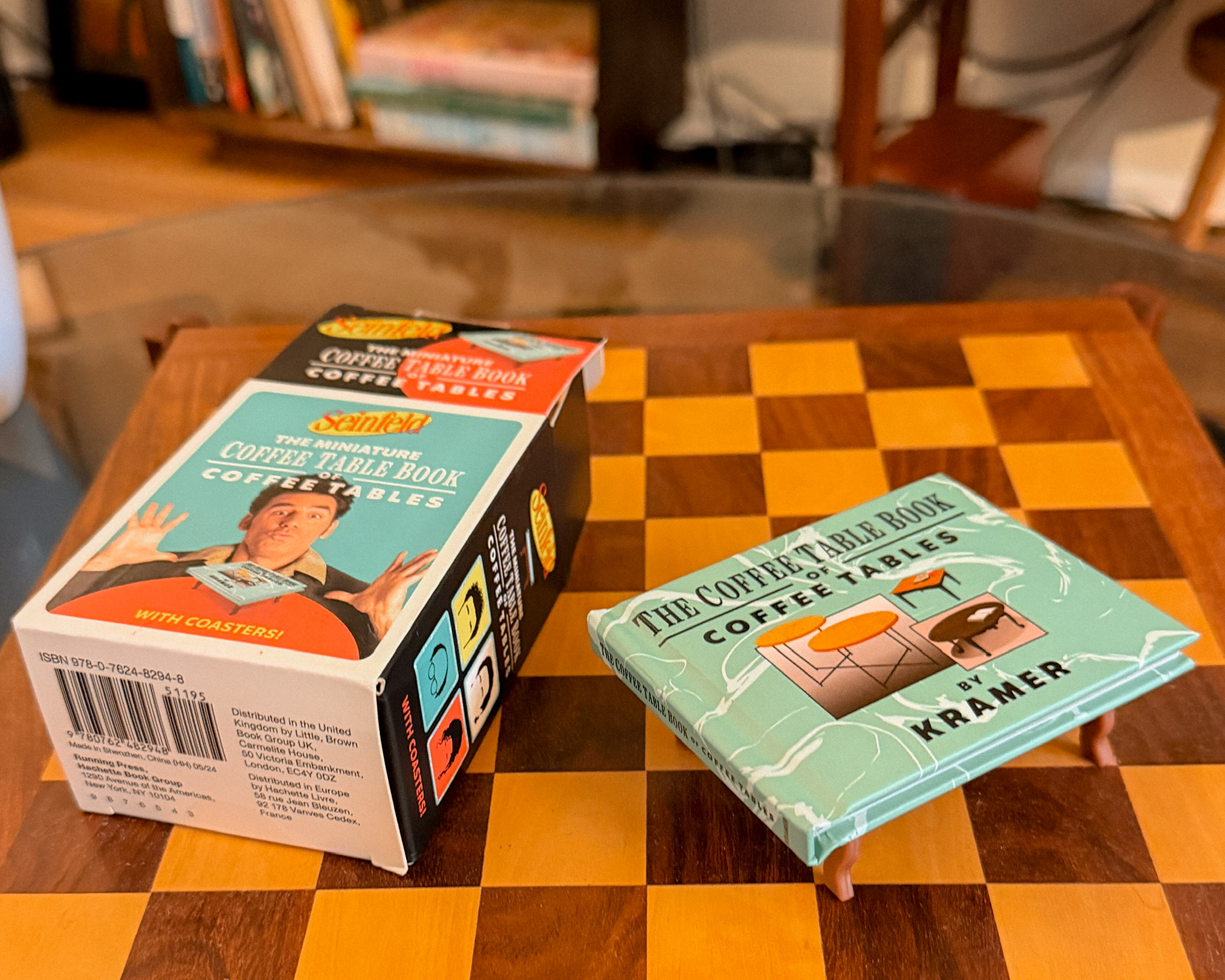
It also explains his best seller. About half of what James sells is coffee tables, mostly to people in apartments. He once planned to open a shop called the Coffee Table Shop, with a big poster of Kramer on the wall. And yes, he has the book. The Coffee Table Book of Coffee Tables, by Kramer. It has little legs!
His advice if you're starting out
Look at other people's listings. Describe the piece as honestly as you can, and don't claim it's pristine if it isn't. Invite people to come and have a look, with no obligation. "I'm doing this as a business. I am not a drive-by."
And the best part of the job? Buyers send him photos of their kids and their dogs sitting on the couch they bought. Then they come back and buy again.
The gossip bench
When James gave a talk on AI and the future of work, the first slide was a gossip bench... one I had listed on Stuff Exchange myself! Someone made that little telephone table for a very good reason: the phone lived in the hallway, cord and all.
Then phones changed, and the maker moved on to CD cabinets. Then those went too.
Things move on, and James is all for it. "A positive anything is better than a negative nothing."
So next time you're staring at a listing, wondering if you've got the price right... start at the end and work back.
And be curious, not judgemental, as Ted Lasso would say. Even about your own prices.
Follow James's finds on Instagram at @midcentury_jimmyg, or see what he has listed on Stuff Exchange below.
Have a fab week!
Romana
PS. Curious about gossip benches? There's a whole article on them over on the Stuff Exchange blog.